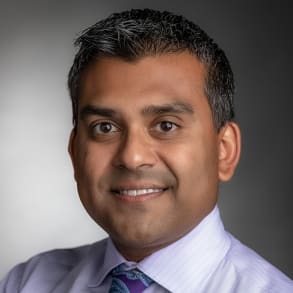
Chapters Transcript Video Talazoparib + Tazemetostat Presented by Atish Choudhury, MD, PhD. Dr. Atish Choudhury presented clinical trial results evaluating the combination of talazoparib and tazemetostat in advanced prostate cancer. Talis operative is in a class of drugs called PARP inhibitors, uh, which is approved for metastatic castration resistant prostate cancer in combination with a hormonal drug called azularide for patients with defects in the DNA damage repair response. Um, data from labs at Dana-Farber, including Doctor Miles Brown's lab and Doctor Misha Beltran's labs. Um, suggest that, uh, actually combining a PARP inhibitor with the inhibitor of a molecule called ECH2, um, might allow this uh DNA damage repair targeting strategy to work even in patients who don't have mutations in genes that would predict for a defect in the DNA damage repair. And so um we submitted a uh proposal for funding of this combination with the PARP inhibitor Talazoperab with the ECH2 inhibitor Tazimmitastat, um, that was fun uh funded through a prostate Cancer Foundation, uh, Pfizer Global Challenge award. In the part one A of the study, we defined the, uh, Recommended dose for expansion at Talis opera 0.75 mg daily, which is about 75% of the approved dose in monotherapy with tasimmitastat at 800 mg twice daily. So that was what was used for expansion for 20 additional patients. So we had 27 total patients who were treated at this dose where we were able To assess for um clinical outcomes. And so what we concluded was that um in this heavily pre-treated and by a micro and selected population, this combination of the two drugs was associated with expected um suppression of the bone marrow, but otherwise acceptable safety profile and the clinical benefit was seen in a minority of patients. So what we're doing now in Um, studies that are funded through the National Cancer Institute through their spore mechanism is to look for biomarkers in the pre-treatment and on-treatment biopsy specimens and blood collections to really try to identify the subset of patients who really experience uh favorable outcomes with this particular regimen to then potentially test in the future. Published June 11, 2025 Created by Related Presenters Atish D. Choudhury, MD, PhD Medical Oncology View full profile